
Last reviewed: November 26, 2026
Peptides are short chains of amino acids that act as biological signals, hormones and other functional molecules. More than 80 peptide drugs have reached the market since insulin was introduced in the 1920s. However, interest in unapproved injectable peptides has grown faster than the clinical evidence supporting their use. This article explains how peptides are synthesized, how researchers use them, what benefits approved peptide medicines offer and which side effects deserve attention. It also examines the differences between approved medicines, compounded preparations and research-use-only products. Written by Dr. Kenzie Hart, MD, an endocrinologist with experience in peptide chemistry and laboratory research.
This article provides general educational information. It is not a substitute for an individual medical assessment or advice from a qualified healthcare professional.
What Are Peptides?
A peptide is a short chain of 2 to about 50 amino acids joined by peptide bonds. The body uses peptides as hormones, neurotransmitters and signaling molecules, and laboratories synthesize them for research and as approved medicines such as oxytocin, semaglutide and tirzepatide.
Amino acids are the building blocks of peptides and proteins. Each amino acid contains an amino group, a carboxyl group and a distinctive side chain. The side chain gives each amino acid its chemical characteristics.
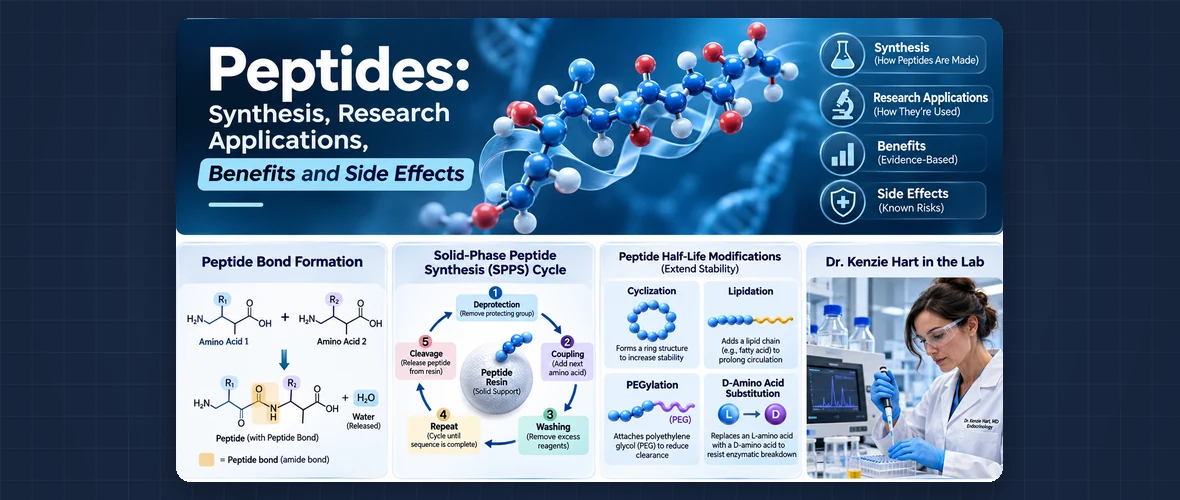
A peptide bond is an amide bond formed when the carboxyl group of one amino acid reacts with the amino group of another. This reaction releases a water molecule. The resulting peptide backbone contains a repeating sequence of atoms, while the side chains extend from that backbone.
A peptide sequence is written from its N-terminus to its C-terminus. The N-terminus contains the free amino group, while the C-terminus contains the free carboxyl group. The order of amino acid residues determines the peptide’s primary structure and influences its shape, stability and biological activity.
Peptides have several origins. Human cells produce peptides from precursor proteins through enzymatic processing. Digestion releases smaller peptides from dietary proteins. Laboratories can also synthesize peptides through chemical methods or produce them using recombinant DNA technology.
How Are Peptides Different From Proteins?
Peptides differ from proteins mainly in size: a peptide has about 2 to 50 amino acids, while a protein usually has more and folds into a stable three-dimensional shape.
| Feature | Peptide | Protein |
|---|---|---|
| Length | Commonly 2 to about 50 amino acids | Usually longer than 50 amino acids |
| Molecular weight | Therapeutic peptides commonly fall around 500 to 5,000 Da | Often substantially larger |
| Structure | May be linear or cyclic and may have limited folding | Commonly has defined secondary and tertiary structures |
| Stability | Many are susceptible to enzymatic degradation | Stability varies with structure and environment |
| Production | Chemical synthesis, biological production or enzymatic methods | Commonly produced through cellular protein synthesis or recombinant expression |
| Examples | Oxytocin, vasopressin and semaglutide | Collagen, albumin and hemoglobin |
Da means dalton, a unit of molecular mass. The molecular-weight ranges are typical descriptions, not strict classification rules.
The distinction between peptides and proteins is not absolute. The 50-amino-acid boundary is a convention rather than a universal chemical rule. Insulin contains 51 amino acids across two chains and is commonly classified as a peptide hormone.
What Are the Main Types of Peptides?
Peptides are classified by length, structure and biological function. These classifications describe different aspects of the same molecule and can overlap.
Classification by length
- Dipeptides: Dipeptides contain two amino acid residues joined by one peptide bond.
- Tripeptides: Tripeptides contain three amino acid residues connected by two peptide bonds.
- Oligopeptides: Oligopeptides are relatively short amino acid chains, although the exact length used for this category varies between scientific sources.
- Polypeptides: Polypeptides are longer amino acid chains that may fold into biologically active structures or form parts of proteins.
Classification by structure
- Linear peptides: Linear peptides have an open chain with identifiable N-terminal and C-terminal ends.
- Cyclic peptides: Cyclic peptides contain a ring structure formed through a connection between different parts of the molecule.
- Lipopeptides: Lipopeptides contain a lipid component attached to a peptide structure.
- Glycopeptides: Glycopeptides contain one or more carbohydrate groups attached to the peptide.
Classification by biological function
- Peptide hormones: Insulin and glucagon-like peptide-1 (GLP-1) participate in endocrine signaling.
- Neuropeptides: Oxytocin, vasopressin and endorphins act as signaling molecules in the nervous and endocrine systems.
- Antimicrobial peptides: Defensins and LL-37 are examples of peptides involved in innate immune defense.
- Signal peptides: Signal peptides help direct newly synthesized proteins toward particular cellular locations or secretion pathways.
How Do Peptides Work in the Body?
Most peptides work by binding to a specific receptor on a cell, which switches a signaling pathway on or off.
A receptor is a protein that recognizes a particular signaling molecule. Receptor binding can change the receptor’s shape and initiate a series of events inside the cell.
Many peptide receptors belong to a family called G protein-coupled receptors (GPCRs). These receptors transmit signals across cell membranes through interactions with intracellular G proteins.
The GLP-1 receptor provides an example. GLP-1 binds to this receptor on pancreatic cells and activates intracellular signaling. This contributes to glucose-dependent insulin secretion and other physiological responses.
Peptide activity depends on several factors. These include amino acid sequence, receptor affinity, receptor distribution, metabolic stability and the amount of peptide reaching the target tissue.
Many natural peptides have short half-lives. A half-life is the time required for the concentration of a substance in the body to decrease by half. Enzymes called proteases break down peptide bonds, while the kidneys help remove circulating peptides and their metabolites.
Native GLP-1 has a half-life of approximately one to two minutes. The enzyme dipeptidyl peptidase-4 (DPP-4) rapidly degrades native GLP-1, while renal clearance also contributes to its short circulation time. [1]
Chemical modifications can change how long a peptide remains active. These modifications are important in the design of peptide medicines.
How Are Peptides Synthesized?
Peptides are made in four main ways: solid-phase synthesis, liquid-phase synthesis, recombinant DNA expression and enzymatic ligation.
Each method has different advantages. The choice depends on peptide length, sequence complexity, required modifications, production scale and intended application.
| Method | Best suited for | Main strength | Main limitation | Example |
|---|---|---|---|---|
| Solid-phase peptide synthesis (SPPS) | Short and medium-length synthetic peptides | Controlled stepwise assembly and broad chemical flexibility | Deletion sequences and incomplete reactions can create impurities | Modified research peptides |
| Liquid-phase synthesis | Short peptides and fragment assembly | Suitable for solution-based chemical production | Intermediates require separation and purification | Peptide fragments |
| Recombinant DNA expression | Peptides and proteins compatible with biological production | Uses cellular machinery for production | Non-natural amino acids and some modifications are difficult to introduce | Recombinant human insulin |
| Enzymatic ligation | Joining peptide fragments | Can provide selective bond formation under suitable conditions | Requires appropriate substrates and reaction conditions | Chemically prepared peptide fragments |
The synthesis method determines how a peptide is assembled. Purification and analytical testing then help establish its identity and quality.
Dr. Hart’s laboratory perspective: This section requires Dr. Hart’s direct first-hand contribution. Insert a short account of the synthesis methods used in her laboratory, including the specific applications of Fmoc/Boc solid-phase synthesis, cyclization and lipidation. Do not publish an assumed first-person account without her approval.
What Is Solid-Phase Peptide Synthesis (SPPS)?
Solid-phase peptide synthesis builds a peptide one amino acid at a time while the growing chain stays anchored to an insoluble resin bead.
R. Bruce Merrifield introduced solid-phase peptide synthesis in 1963. His work transformed peptide chemistry by allowing researchers to assemble peptides while keeping the growing chain attached to a solid support. Merrifield received the 1984 Nobel Prize in Chemistry for this work. [2]
SPPS uses a repeating cycle of protection, deprotection and coupling. Protecting groups temporarily block reactive chemical groups so that the desired peptide bond forms at the correct position.
The general process follows these stages:
- Resin attachment: The first amino acid, usually representing the C-terminal residue, is attached to an insoluble resin.
- Deprotection: A temporary protecting group is removed to expose the amino group needed for the next coupling reaction.
- Coupling: The next protected amino acid reacts with the exposed amino group through a coupling reagent.
- Washing: Excess amino acids, coupling reagents and reaction by-products are removed.
- Cycle repetition: Deprotection, coupling and washing are repeated until the required sequence is assembled.
- Cleavage: The completed peptide is separated from the resin, and remaining side-chain protecting groups are removed.
- Purification: The crude peptide is purified and characterized before further processing, which may include freeze-drying.
The efficiency of each coupling step affects the final product. Incomplete reactions can create deletion sequences, while side reactions can produce additional impurities.
SPPS is widely used because it supports sequence-specific synthesis and many chemical modifications. However, longer sequences can become more difficult to synthesize because incomplete coupling events accumulate across repeated cycles.
What Is the Difference Between Fmoc and Boc Chemistry?
Fmoc and Boc are the two protecting-group strategies commonly used in SPPS: Fmoc is removed with a base, while Boc is removed with acid.
Fmoc means 9-fluorenylmethoxycarbonyl. Boc means tert-butyloxycarbonyl. Both groups temporarily protect the amino group of an amino acid during peptide assembly.
| Feature | Fmoc chemistry | Boc chemistry |
|---|---|---|
| Protecting group | Fmoc | Boc |
| Removal | Base-mediated deprotection | Acid-mediated deprotection |
| Typical deprotection approach | Piperidine-based conditions | Acidic conditions |
| Final cleavage | Acidic cleavage, commonly using trifluoroacetic acid | Historically uses stronger acid conditions, including hydrogen fluoride in classic protocols |
| Main characteristic | Orthogonal protection strategy with comparatively mild repeated deprotection | Established method with different acid-based protection and cleavage chemistry |
| Current use | Widely used in modern SPPS | Still used in selected synthesis applications |
Orthogonal protection means that different protecting groups can be removed under different chemical conditions. This allows chemists to expose selected functional groups while protecting others.
Fmoc chemistry is widely used because its repeated deprotection steps avoid the strong acid conditions historically associated with Boc-based final cleavage. The appropriate strategy still depends on the peptide sequence, required modifications and synthesis design.
What Is Liquid-Phase Peptide Synthesis?
Liquid-phase peptide synthesis builds a peptide in solution rather than keeping the growing chain attached to a solid resin.
Each reaction produces an intermediate that must be separated and purified before the next chemical step. Protecting groups control which functional groups participate in each reaction.
Liquid-phase synthesis can be useful for short peptides and large production batches. It can also support fragment condensation, in which separately synthesized peptide fragments are joined to create a longer sequence.
Hybrid approaches combine SPPS and liquid-phase chemistry. A laboratory may prepare individual fragments through solid-phase synthesis and then join them through solution-based reactions.
The choice depends on the sequence, scale, chemical requirements and purification strategy. Neither method is universally superior for every peptide.
How Are Peptides Made With Recombinant DNA?
Recombinant production puts the gene for a peptide into bacteria or yeast, which then make the encoded product as they grow.
Recombinant DNA technology combines genetic material from different sources. Scientists insert a selected DNA sequence into an expression system so that the host cell produces the desired peptide or protein.
Common production hosts include Escherichia coli (E. coli) and yeast. The expression system, host strain and production conditions influence yield and product characteristics.
Recombinant human insulin is an important example. Recombinant production replaced the earlier dependence on insulin extracted from animal pancreases.
Biological production has limitations. Cells do not easily incorporate every non-natural amino acid or perform every chemical modification required for a designed peptide. Some products therefore require additional chemical processing after expression.
How Are Synthetic Peptides Purified and Tested?
After synthesis, peptides are commonly purified by reverse-phase high-performance liquid chromatography (RP-HPLC), and their molecular identity can be assessed using mass spectrometry.
Purification and characterization answer different questions. Purification estimates how much of the detected material corresponds to the desired peptide. Characterization helps determine whether the expected molecular structure is present.
Purity: RP-HPLC separates components based on their interactions with a stationary phase and a liquid mobile phase. The chromatogram displays peaks representing detected components. Purity is often reported as the percentage of the total integrated peak area assigned to the main peptide peak. This percentage does not necessarily equal the amount of peptide by weight.
Identity: Liquid chromatography-mass spectrometry (LC-MS) combines chromatographic separation with mass analysis. The measured mass can be compared with the calculated mass of the expected peptide. This helps assess molecular identity but does not independently establish every aspect of structural correctness.
Net peptide content: The mass of a peptide powder can include water, residual solvents, counter-ions and other material. Trifluoroacetate (TFA) and acetate are examples of counter-ions associated with peptide preparations. Consequently, chromatographic purity and net peptide content are different measurements.
Endotoxin and sterility: Endotoxin testing evaluates bacterial endotoxin contamination. Sterility testing evaluates whether viable microorganisms are detected under the test conditions. These tests are particularly relevant to products intended for parenteral use, but one test cannot substitute for the other.
A certificate of analysis (CoA) should identify the tested material, batch or lot, analytical methods, results and acceptance criteria. Relevant data may include chromatographic purity, molecular mass, peptide content, counter-ion information and applicable microbiological testing.
A CoA should be interpreted according to the actual methods and results reported. A single purity percentage does not establish sterility, safety, biological activity or suitability for clinical use.
Dr. Hart’s laboratory perspective: Dr. Hart should add a verified example of how her laboratory evaluates peptide identity, chromatographic purity and peptide content. Include actual analytical methods only where they are used and documented.
How Are Peptides Modified to Last Longer?
Chemists extend a peptide’s half-life by changing its structure so enzymes break it down and the kidneys clear it more slowly.
These modifications can influence stability, receptor binding, distribution and biological activity. Their effects depend on the specific sequence and molecular design.
- Cyclization: Cyclization creates a ring by connecting different parts of a peptide. This can restrict molecular flexibility and increase resistance to some forms of enzymatic degradation.
- Lipidation: Lipidation attaches a lipid component, often a fatty-acid chain, to a peptide. Some lipidated peptides bind albumin, which can alter distribution and prolong circulation. Semaglutide is a clinically established example.
- PEGylation: PEGylation attaches polyethylene glycol to a molecule. This can change its hydrodynamic size and influence circulation time and clearance.
- D-amino acids: Replacing selected L-amino acids with D-amino acids can change peptide conformation and resistance to enzymatic degradation.
- N-methylation: N-methylation adds a methyl group to a peptide backbone nitrogen. This can influence hydrogen bonding, conformation and protease susceptibility.
- Stapled peptides: Stapling introduces a chemical bridge between selected residues. This can stabilize a preferred helical structure in suitable peptide designs.
- Single amino acid substitution: Replacing one amino acid can alter receptor binding, stability, selectivity and other molecular properties.
The relationship between peptide structure and biological activity is called a structure-activity relationship (SAR). A single residue change can alter how a peptide interacts with its target. The effect may involve potency, selectivity, stability or molecular conformation.
Dr. Hart’s laboratory perspective: Add a specific, documented example from Dr. Hart’s own work showing how a sequence change or chemical modification affected an analytical or experimental result. Do not imply a clinical benefit from laboratory observations.
What Are Peptides Used For in Research?
Researchers use peptides as drug candidates, tools for studying biological processes and diagnostic agents.
Peptide research covers several areas of biology and medicine. Researchers investigate naturally occurring peptides, synthetic sequences and modified molecules to understand molecular interactions and identify possible therapeutic applications.
A 2025 review reported more than 200 peptides in clinical development. This figure describes candidates at different development stages, not approved medicines or proven treatments.
Drug Discovery and Peptide Therapeutics
Peptides contribute to drug discovery because they can interact with biological targets that are difficult to address using some small-molecule drugs.
More than 80 peptide drugs have reached the market since insulin was introduced. Their approved uses span several areas, including diabetes, cancer, osteoporosis, multiple sclerosis, HIV infection and chronic pain. [3]
Researchers use peptide libraries to screen many different sequences for interactions with a target. Display technologies can present large collections of peptides for selection based on binding or other properties.
Natural sources also contribute to peptide discovery. Animal venoms contain peptides that interact with ion channels, receptors and other biological targets. These molecules can provide starting points for studying biological mechanisms and designing new compounds.
Peptide discovery does not end with identifying a sequence. Researchers must evaluate its target interaction, stability, selectivity, pharmacokinetics and safety before considering clinical development.
Metabolic and Endocrine Research
Metabolic and endocrine research examines peptides that regulate glucose, appetite, energy balance and hormonal signaling.
Insulin is a central example. It is a peptide hormone produced by pancreatic beta cells and plays a major role in regulating blood glucose.
GLP-1, glucose-dependent insulinotropic polypeptide (GIP), glucagon and amylin are other important molecules in metabolic research. Their receptors and signaling pathways are investigated to understand glucose regulation, appetite and metabolic physiology.
GLP-1 receptor agonists provide an established clinical example. Semaglutide and liraglutide are peptide-based medicines used for specific FDA-approved indications. Tirzepatide activates both GIP and GLP-1 receptors and has approved indications that must be checked against its current prescribing information.
Research also examines insulin analogs. These molecules have structural changes that influence their absorption, distribution or duration of action.
The endocrine effects of a peptide depend on its target, receptor distribution and physiological context. Findings from one peptide cannot automatically be applied to another member of the same broad class.
Neuroscience and Blood-Brain Barrier Research
Neuroscience research examines neuropeptides and their roles in communication between neurons and other cells.
Oxytocin and neuropeptide Y are examples of peptides involved in nervous-system signaling. Their functions include complex interactions with behavioral, autonomic and endocrine pathways.
The blood-brain barrier is a specialized interface that regulates the movement of substances between circulating blood and the central nervous system. Many peptides do not cross this barrier efficiently because of their size, polarity and susceptibility to degradation.
Researchers investigate several approaches to peptide delivery and molecular design. These include lipidation, shuttle peptides and intranasal delivery systems. Each approach has distinct limitations and requires evidence from appropriate experimental models.
Intranasal delivery does not automatically establish that a peptide reaches the brain at a clinically meaningful concentration. Distribution, metabolism and exposure must be measured in relevant studies.
Dr. Hart’s research perspective: Insert a verified first-hand observation from Dr. Hart’s neuroscience or peptide-delivery research. Specify the experimental context and distinguish laboratory findings from clinical evidence.
Antimicrobial and Immune Research
Antimicrobial peptide research examines small molecules involved in the body’s defense against microorganisms.
Defensins and LL-37 are examples of antimicrobial peptides associated with innate immunity. Researchers study their interactions with microbial membranes and other biological targets.
Antimicrobial peptides are also investigated as possible starting points for research into antimicrobial resistance. However, laboratory activity does not establish that a peptide is an effective or safe treatment for an infection in humans.
Epitope peptides have another role in immune research. An epitope is a specific molecular region recognized by an antibody or immune-cell receptor. Researchers use selected peptide sequences in vaccine design, immune assays and studies of antigen recognition.
Diagnostics and Imaging
Peptides can act as molecular recognition components in diagnostic research and medical imaging.
Some radiolabeled peptides bind to receptors expressed by particular cells or tumors. Researchers use these interactions to investigate imaging methods, including techniques for identifying certain neuroendocrine tumors.
Peptide-based imaging depends on receptor expression, binding characteristics, labeling chemistry and the behavior of the resulting molecule in the body.
Peptides also serve as analytical standards in mass-spectrometry-based proteomics. These standards help researchers identify or quantify selected proteins and peptide fragments in biological samples.
Skin and Cosmetic Research
Skin and cosmetic research investigates peptides with different proposed roles, including collagen-derived peptides, signal peptides and copper-binding peptides.
Oral collagen peptides are fragments produced by breaking down collagen proteins. Clinical studies have investigated whether these supplements influence skin hydration and elasticity. A systematic review of randomized trials reported positive findings, but study quality, heterogeneity and funding-related limitations affect interpretation. [4]
Signal peptides are short sequences studied for their role in cellular communication and protein processing. Some topical cosmetic formulations contain synthetic peptides designed to interact with skin-related biological pathways. The presence of a peptide in a cosmetic product does not establish a clinically meaningful effect.
GHK-Cu is a copper-binding tripeptide studied in laboratory and other research settings. Its proposed biological activities require evaluation by evidence type. Findings from cell or animal studies should not be presented as established human clinical benefits.
What Are the Benefits of Peptides?
The proven benefits of peptides come from approved peptide medicines, while many benefits claimed for unapproved peptides rest on cell and animal studies.
The evidence varies substantially between peptide types. An FDA-approved medicine has undergone regulatory review for specific indications. An experimental peptide may have only preliminary laboratory or animal findings.
| Peptide type | Example | Evidence context | US regulatory context |
|---|---|---|---|
| Approved peptide medicines | Insulin, semaglutide, teriparatide | Clinical trials and regulatory review for specific indications | FDA-approved for specified uses |
| Metabolic peptide medicines | Semaglutide, liraglutide, tirzepatide | Clinical evidence for their labeled indications | FDA-approved products with specific labels |
| Oral collagen supplements | Collagen peptides | Randomized trials and systematic reviews, with limitations | Marketed as dietary supplements, not FDA-approved drugs |
| Unapproved injectable peptides | BPC-157, TB-500 and GHK-Cu | Varying amounts of preclinical and limited human evidence | Not FDA-approved medicines for general therapeutic use |
The term peptide does not establish efficacy. Evidence must be assessed for each individual molecule, formulation, indication and route of administration.
What Advantages Do Peptide Drugs Have Over Small Molecules?
Peptide drugs can bind selected biological targets with high specificity and potency, while the body can break many peptides down into amino acids and smaller fragments.
Potential advantages
- Specificity: A peptide sequence can be designed to interact with a particular receptor or molecular target.
- Potency: Some peptides produce strong biological effects at relatively low concentrations because of their target interactions.
- Biological compatibility: Many peptides are composed of amino acids that the body already processes through normal metabolic pathways.
- Access to selected targets: Peptides can interact with certain protein surfaces and protein-protein interactions that may be difficult to target with small molecules.
- Design flexibility: Chemical synthesis allows researchers to modify sequences and investigate structure-activity relationships.
These advantages are not universal. A peptide’s behavior depends on its sequence, target, formulation and pharmacological properties.
Limitations
- Short half-life: Many natural peptides are rapidly degraded by proteases.
- Oral absorption: Many peptides are broken down in the gastrointestinal tract or absorbed poorly.
- Delivery challenges: Some peptide medicines require injection or specialized delivery systems.
- Manufacturing complexity: Peptide synthesis, purification and analytical testing can be technically demanding.
- Cost: Manufacturing costs vary with sequence length, modifications, production scale and quality requirements.
- Immunogenicity: Some peptide medicines can trigger immune responses, including antibody formation.
Peptide medicines are therefore not automatically safer, cheaper or more effective than small-molecule medicines. Each product requires independent clinical and regulatory evaluation.
Which Peptide Medicines Are FDA-Approved?
The FDA has approved many peptide-based medicines for specific medical conditions. The exact approved indication depends on the product, formulation and current prescribing label.
Examples include:
| Medicine | Peptide class or target | Example of an approved use |
|---|---|---|
| Insulin products | Insulin and insulin analogs | Blood glucose management in specified diabetes populations |
| Semaglutide | GLP-1 receptor agonist | Specific indications involving type 2 diabetes, chronic weight management and other labeled uses |
| Liraglutide | GLP-1 receptor agonist | Type 2 diabetes and weight management indications, depending on product |
| Tirzepatide | GIP and GLP-1 receptor agonist | Type 2 diabetes and chronic weight management indications, depending on product |
| Teriparatide | Parathyroid hormone analog | Selected osteoporosis indications |
| Leuprolide | Gonadotropin-releasing hormone (GnRH) analog | Selected hormone-sensitive conditions |
| Octreotide | Somatostatin analog | Selected endocrine and neuroendocrine conditions |
| Oxytocin | Peptide hormone | Specific obstetric indications |
| Desmopressin | Vasopressin analog | Selected conditions involving water balance or bleeding |
| Tesamorelin | Growth hormone-releasing hormone analog | Reduction of excess abdominal fat in adults with HIV-associated lipodystrophy |
This table provides examples, not a complete list of approved products. Approval may differ by formulation and indication. Before publication, each row must be checked against the current FDA-approved label in Drugs@FDA.
An approved medicine’s status does not transfer to other peptides with similar structures or proposed mechanisms. FDA approval applies to the specific product and its approved labeling.
Do Collagen and Other Supplement Peptides Work?
Oral collagen peptides have some clinical evidence for improving skin hydration and elasticity, but the strength of the evidence remains subject to study quality and limitations.
Collagen supplements contain hydrolyzed collagen, which is broken into smaller peptide fragments. Researchers have investigated their effects on skin hydration, elasticity and other measurements associated with skin appearance.
Randomized controlled trials have reported improvements in some skin measurements. However, trial populations, supplement formulations, study durations and outcome measures vary. A 2025 systematic review also found that results differed when studies were grouped by funding source and quality. [5]
The evidence does not establish that every collagen product produces the same effect. It also does not demonstrate that collagen supplements reverse skin aging or treat a medical condition.
Dietary supplements are regulated differently from prescription medicines in the United States. The FDA does not approve dietary supplements for effectiveness before they reach the market.
What Are the Side Effects of Peptides?
Side effects depend on the peptide: approved medicines have known adverse effects listed on their labels, while unapproved peptides may have unknown risks.
A peptide’s safety profile depends on its molecular structure, target, formulation, route of administration, exposure and the characteristics of the person receiving it.
Approved medicines undergo clinical testing and regulatory review for specified indications. Their labels describe common adverse reactions, serious warnings, contraindications and known drug interactions.
Unapproved peptides may lack adequate human safety data. The absence of reported adverse effects does not demonstrate that a peptide is safe.
What Are the Common Side Effects of Peptide Injections?
Peptide injection side effects vary by product, but may include local irritation, digestive symptoms, headache, fatigue and allergic reactions.
- Injection-site reactions: Redness, pain, swelling or irritation can occur after an injection. The frequency and severity depend on the product and formulation.
- Digestive effects: Nausea, diarrhea, vomiting, constipation and abdominal discomfort are reported with several peptide-based medicines, including GLP-1 receptor agonists.
- Headache and fatigue: These symptoms appear in the prescribing information for some peptide medicines.
- Allergic reactions: Hypersensitivity reactions can occur. Severe reactions, including anaphylaxis, require urgent medical attention.
- Hypoglycemia: Insulin directly lowers blood glucose. Some other glucose-lowering medicines can increase hypoglycemia risk when combined with insulin or insulin secretagogues.
Semaglutide product labeling lists gastrointestinal adverse reactions such as nausea, diarrhea, vomiting, constipation and abdominal pain. Its labeling also includes warnings involving pancreatitis, gallbladder disease, severe gastrointestinal reactions and hypersensitivity. [6]
The risk profile is not identical across peptide medicines. A side effect associated with one medicine should not automatically be attributed to every peptide.
Side Effects by Peptide Class
Peptide side effects vary by pharmacological class, and the relevant product label is the primary source for approved medicines.
| Peptide class | Examples of reported adverse effects | Important safety considerations |
|---|---|---|
| GLP-1 receptor agonists | Nausea, diarrhea, vomiting, constipation and abdominal pain | Product-specific warnings include pancreatitis, gallbladder disease and hypersensitivity |
| Insulin | Hypoglycemia, weight gain and injection-site reactions | Severe hypoglycemia can be life-threatening |
| Growth hormone-releasing peptide medicines | Effects depend on the specific medicine and its regulatory status | Do not assume a common safety profile across unapproved products |
| Unapproved injectable peptides | Unknown or incompletely characterized adverse effects | Human safety, product identity, purity and consistency may be uncertain |
For incretin medicines, the current prescribing information should be consulted because adverse reactions and warnings differ between products. The semaglutide label, for example, includes a boxed warning concerning thyroid C-cell tumors observed in rodents. It contraindicates use in people with a personal or family history of medullary thyroid carcinoma (MTC) or multiple endocrine neoplasia syndrome type 2 (MEN 2). [6]
What Are the Risks of Unapproved and Research-Use-Only Peptides?
The main risks of unapproved peptides are uncertain human safety, potential impurities and inconsistent product quality, because these products have not undergone the same regulatory review as approved medicines.
A research-use-only (RUO) label means that a product is intended for research and is not represented as a medicine for human use. It does not establish that the product is safe for injection or self-administration.
Several issues deserve attention:
- Limited human evidence: Many unapproved peptides have not been evaluated in large, well-controlled human clinical trials.
- Product identity: A label may not independently prove that a product contains the stated peptide or concentration.
- Impurities: Inadequate manufacturing controls can introduce residual solvents, synthesis by-products or other contaminants.
- Immune reactions: Unexpected impurities, aggregates or molecular characteristics may contribute to immune responses.
- Inconsistent quality: Products from different sources may vary in identity, purity, content and manufacturing controls.
- Unknown interactions: Drug interactions and long-term effects may not have been adequately studied.
BPC-157, TB-500 and GHK-Cu are examples of peptides discussed in research and commercial contexts. Their proposed applications should not be confused with established clinical indications.
A laboratory finding does not establish human safety or therapeutic effectiveness. Animal studies cannot be treated as proof of benefit in people. A registered clinical trial also does not mean that a product has been proven effective.
Sports regulations create an additional concern. The 2026 World Anti-Doping Agency (WADA) Prohibited List includes non-approved substances under S0 and peptide hormones, growth factors and related substances under S2. TB-500 is specifically identified in WADA’s technical documentation. Athletes subject to anti-doping rules should check the current prohibited list and obtain qualified advice. [7]
Who Should Avoid Peptide Therapy?
People who are pregnant, have relevant medical conditions, compete in tested sports or take medicines with potential interactions should seek medical advice before considering a peptide medicine.
The risks depend on the individual product and the person’s medical history. A contraindication for one peptide medicine does not automatically apply to every peptide.
For example, semaglutide products carry a contraindication for people with a personal or family history of MTC or a diagnosis of MEN 2. The prescribing information also contains pregnancy-related guidance for specific indications. [6]
People with a history of serious allergic reactions, significant gastrointestinal disease, endocrine conditions or complex medication regimens may need additional clinical assessment.
A healthcare professional should review the specific product, its regulatory status, the intended indication and the available safety evidence. Research-use-only products should not be treated as substitutes for approved medical treatment.
How Are Peptides Regulated in the US?
In the United States, peptide products can fall under different regulatory pathways depending on their intended use, formulation and legal classification. FDA-approved medicines, compounded drugs, dietary supplements and research-use-only products are not interchangeable categories.
FDA-approved medicines have undergone FDA review for specific indications and conditions of use. Their approved labels define the population, indication, warnings and other requirements.
Compounded drugs are prepared by licensed pharmacies or other permitted facilities under applicable federal and state requirements. Compounded drugs are not FDA-approved, and they do not undergo the same premarket review for safety, effectiveness and quality as approved medicines.
Section 503A of the Federal Food, Drug, and Cosmetic Act describes conditions under which qualifying state-licensed pharmacies and physicians may compound drugs for identified individual patients. The law restricts compounding from bulk drug substances to substances that meet specified statutory and regulatory conditions.
The FDA maintains lists and interim categories for bulk drug substances nominated for compounding. Category 2 identifies substances that may present significant safety risks under the agency’s interim policies. The status of an individual substance must be checked against the current FDA listing. [8]
Dietary supplements are regulated under a different framework. A product marketed as a dietary supplement is not an FDA-approved drug simply because it contains amino acids or peptide-derived ingredients.
Research-use-only products are not approved medicines for human use. A research label does not create an exemption from applicable laws or make a product suitable for human administration.
US Peptide Compounding: Regulatory Update
The FDA’s review of bulk drug substances nominated for compounding has continued through 2026. Advisory committee recommendations and changes to interim categories should not be mistaken for FDA approval.
| Date | Regulatory development | Meaning |
|---|---|---|
| September 2023 | FDA placed several nominated bulk drug substances in Category 2 | The agency identified potential significant safety risks under its interim policies |
| April 2026 | FDA updated the status of certain withdrawn nominations | A nomination withdrawal does not establish that a substance is approved for compounding |
| May 2026 | FDA published an updated 503A bulk drug substances document | The document provides the agency’s current category information at that time |
| July 23–24, 2026 | The Pharmacy Compounding Advisory Committee discussed seven peptide-related substances | The committee considered nominations for possible inclusion on the 503A Bulks List |
| After the advisory meetings | FDA must complete the applicable regulatory process | An advisory vote alone does not add a substance to the statutory bulks list |
At the July 2026 meetings, the committee considered BPC-157, KPV, TB-500, MOTS-C, emideltide (DSIP), Semax and Epitalon. The FDA’s meeting materials identify the substances and uses considered. [9]
The advisory committee process is not equivalent to FDA approval. A favorable committee recommendation does not itself authorize routine compounding or establish clinical efficacy.
The FDA’s bulk drug substance pages can change as nominations are withdrawn, reviewed or updated. The current FDA status should therefore be checked immediately before publication. [8]
When Should You Talk to a Doctor About Peptides?
Talk to a doctor before starting any peptide medicine, especially an injectable product or one that is not FDA-approved.
A clinical discussion should begin with the reason for considering a peptide and whether an established treatment is available. The healthcare professional can then evaluate the relevant evidence, contraindications and potential interactions.
Useful information to bring includes:
- A current list of prescription medicines, over-the-counter medicines and supplements.
- Relevant medical history, including allergies and previous adverse drug reactions.
- Recent laboratory results when they are relevant to the clinical question.
- The exact product name, formulation and source, if a product has already been discussed.
- Any previous treatment response or adverse reaction.
Questions to discuss include:
- Is this peptide FDA-approved for the condition being considered?
- What clinical evidence supports its use, and what risks are known?
- Are there approved alternatives with stronger evidence?
A consultation should distinguish established medical treatment from experimental research. It should also explain what remains uncertain rather than treating preliminary findings as proven benefits.
Frequently Asked Questions
Are Peptides Safe?
Yes, FDA-approved peptide medicines can be appropriate for many people when prescribed and monitored for an approved indication, but unapproved peptides have not been proven safe. Safety depends on the specific molecule, formulation, clinical context and individual health factors. See the side effects and risks sections above.
Are Peptides Steroids?
No, peptides are not steroids: peptides are chains of amino acids, while steroids are lipids built around a four-ring carbon structure. People sometimes confuse them because both appear in sports and performance-related discussions. WADA regulates different substances under separate prohibited classes.
Can Peptides Be Taken by Mouth?
Yes, a few peptide medicines can be taken orally, but many peptides are degraded in the gastrointestinal tract or absorbed poorly. Oral semaglutide is an example of an approved oral peptide medicine. Its formulation and absorption characteristics are product-specific and should not be generalized to other peptides.
Are Peptides Natural?
Yes, the human body produces many peptides naturally, and some peptide medicines are laboratory-made copies or modified versions of naturally occurring molecules. Oxytocin and GLP-1 are examples of naturally occurring peptides. Synthetic production does not automatically make a peptide unsafe, and natural origin does not automatically establish safety.
Is Collagen a Peptide?
No, collagen itself is a large structural protein, but collagen peptides are shorter fragments produced by breaking collagen down. Researchers have studied oral collagen peptides for skin hydration and elasticity. The clinical evidence is mixed in quality, and results should not be generalized to every supplement.
Do Peptides Build Muscle?
No, peptide products marketed for muscle growth should not be assumed to have proven benefits in healthy people. Some peptide hormones and related substances are prohibited in tested sport under WADA rules. Claims about muscle growth require reliable human evidence and must be distinguished from laboratory or animal findings.
Do Peptides Work Right Away?
No, peptides do not all work at the same speed. The onset depends on the specific peptide, formulation, route of administration and biological target. Some insulin preparations begin acting within minutes, while the effects measured with other peptide medicines may develop over longer periods. Product-specific prescribing information provides the relevant details.
References
- Holst JJ. Glucagon-like peptide 1 (GLP-1). Review of GLP-1 physiology and degradation. NCBI/PMC.
- Nobel Prize. The Nobel Prize in Chemistry 1984. R. Bruce Merrifield and solid-phase peptide synthesis. NobelPrize.org.
- Wang L, et al. Therapeutic peptides: current applications and future directions. Signal Transduction and Targeted Therapy. 2022;7:48. PubMed.
- Effects of collagen-based supplements on skin hydration and elasticity: a systematic review and meta-analysis. PubMed.
- Myung SK, et al. Effects of collagen supplements on skin aging: a systematic review and meta-analysis of randomized controlled trials. American Journal of Medicine. 2025. PubMed.
- FDA. Wegovy (semaglutide) prescribing information, revised February 2026. FDA label.
- World Anti-Doping Agency. 2026 Prohibited List. WADA PDF.
- FDA. Certain bulk drug substances for use in compounding that may present significant safety risks. FDA.
- FDA. July 23–24, 2026 meeting of the Pharmacy Compounding Advisory Committee. FDA meeting materials.
This article is for general educational purposes and does not constitute medical advice, diagnosis or treatment. Always consult a qualified healthcare professional about individual medical decisions.